Book Summary
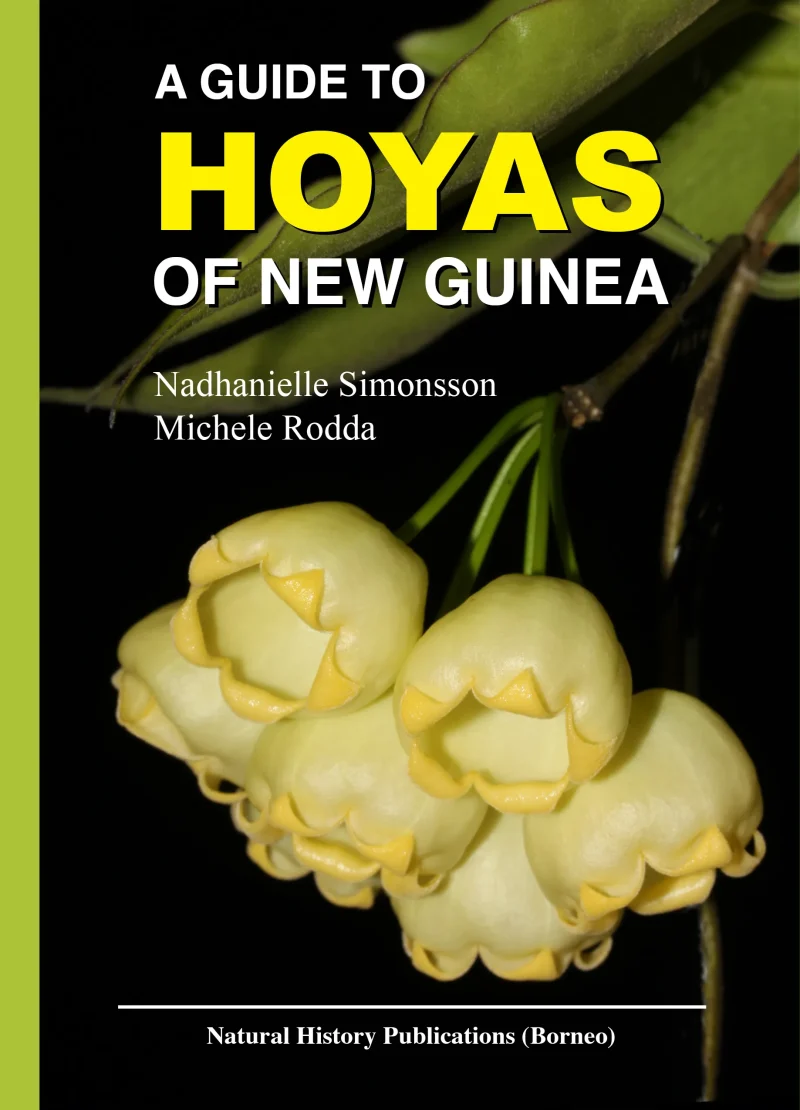
This comprehensive illustrated guide documents all species of Hoya (wax flowers) occurring in New Guinea. The guide includes detailed information on 72 taxa (67 species and five subspecies), featuring the most up-to-date account of the genus in this region until a comprehensive revision can be completed. With exceptional photography and detailed botanical descriptions, it serves as both a scientific reference and a practical guide to one of the world’s most biodiverse regions for Hoya species.
What the Guide Includes
- Detailed species descriptions and identification guides for 72 Hoya taxa (67 species and 5 subspecies)
- Comprehensive botanical illustrations and flower photography
- Information on endemic species unique to New Guinea (86% endemism rate)
- Ecological niche distribution across four elevation ranges (0–2600 m)
- Habitat descriptions and conservation status assessments
- Detailed fieldwork documentation from remote regions of Papua New Guinea and Indonesian New Guinea
- Historical context of Hoya research and exploration in New Guinea since 1830
- Systematics and phylogenetic relationships within the genus
Featured Species & Genera
- Hoya coronaria complex (widespread from southern Thailand to Melanesia)
- Hoya australis (most widespread species, spanning from Borneo to Polynesia with three subspecies in New Guinea)
- Hoya nicholsoniae (reaching Polynesia and New Caledonia)
- Papuahoya (segregate genus endemic to New Guinea, including P. urniflora and P. bykulleana)
- Montane endemics: Hoya krusenstierniana, H. magnifica, H. juhoneweana ssp. lindforsiana
- Lowland specialists: Hoya globulifera, H. archboldiana, H. ischnopus
- Rare species: Hoya inflata (urceolate-globose corolla, recently rediscovered)
Authors and Publisher
- Authors: Nadhanielle Simonsson and Michele Rodda
- Publisher: Natural History Publications (Borneo) Sdn Bhd
- Based on: Intensive fieldwork across Papua New Guinea and Indonesian New Guinea
- Living collections established: Ukarumpa (1500 m highland collection) and Lae (lowland collection)
- Collection partnerships: Singapore Botanic Gardens and Lae Botanic Garden (plants gifted 2017)
Who This Guide Is For
- Hoya enthusiasts, collectors, and horticulturists
- Botanists and naturalists studying New Guinean flora
- Researchers focused on tropical plant diversity, endemism, and evolution
- Plant photographers and field naturalists
- Conservation professionals and biodiversity advocates
- Herbarium curators and taxonomic specialists
- Anyone interested in New Guinea’s unique natural heritage
Ecological Zones & Habitats
- Lowland to lower montane (0–1000 m): Most species-rich zone, comprising approximately 70% of all New Guinean Hoya species
- Hill forest (1000–1500 m): Fewer species recorded, but almost all endemic to New Guinea (e.g., H. juhoneweana ssp. lindforsiana)
- Cloud forest (1500–2000 m): Even fewer species, virtually all endemic; cool montane specialists like H. edholmiana and H. magnifica
- Mossy alpine forest (2000–2600 m): Only Hoya krusenstierniana (including ssp. laticorolla) and H. venusta recorded
- Savannah woodlands: Semi-arid adapted species in Trans-Fly region (southern New Guinea)
- Habitat types: Epiphytic (majority), terrestrial, hemi-epiphytic, and moss-covered habitats across all zones
Corolla Diversity & Flower Characteristics
- Eight corolla types documented: rotate, campanulate, reflexed, reflexed with revolute lobes, inflexed, urceolate-globose, salverform, and tubular
- New Guinea specimens display seven of eight types (tubular absent)
- Hoya versteegii (endemic to New Guinea) and H. telosmoides (Borneo) are the only two species with salverform corollas
- Predominantly two colour patterns: white flowers with white or crimson coronas; creamy yellow, pink, or wine-red with matching coronas
- Flower size ranges from 2.5–3 cm (tiny species like H. pulchella and H. oligantha) to over 4 cm in 13 campanulate species
- Corolla shapes correlate with ecological niche and light exposure
Endemism & Biogeography
- 86% endemic taxa: Of 72 taxa, only 10 are found elsewhere; 62 taxa endemic to New Guinea and Bismarck Archipelago
- Highest endemism rate in region: 50% of Hoya species in Borneo are endemic by comparison
- Widespread species (8 non-endemic): H. anulata, H. australis, H. coronaria, H. globulifera, H. inconspicua, H. ischnopus, H. nicholsoniae, and H. subglabra
- Hoya australis spans from Borneo to Polynesia and Australia (widest distribution)
- Hoya inconspicua extends to Melanesia; H. ischnopus recently found in Sulawesi
- Papuahoya species entirely New Guinea endemic
Conservation Status & Threats
- Vulnerable species: 65 of 72 taxa (90%) are endemic with restricted ranges, facing high extinction risk
- Not vulnerable: Only 8 adaptable, widespread species (H. anulata, H. australis, H. coronaria, H. globulifera, H. inconspicua, H. ischnopus, H. nicholsoniae, H. subglabra)
- Data Deficient: Many species documented only from decades-old herbarium specimens with no recent field records
- Primary threats: Logging, conversion to oil palm plantations, uncontrolled bushfires from slash-and-burn agriculture
- Protected areas: Indonesian New Guinea has ~20% land protection; Papua New Guinea has only ~4%
- Positive factor: Hoya easily propagated from cuttings; minimal horticultural collection pressure on wild populations
- Example of extinction risk: Hoya inflata (last wild collection 1992, believed extinct until Indonesian rediscovery)
Fieldwork Challenges & Methodology
- Access difficulties: Inaccessible primary forests, limited road infrastructure, mountainous terrain up to 4,884 m (Puncak Jaya)
- Transportation: Small aircraft, dugout canoes, and multi-day hikes required to reach remote villages
- Critical discovery: Field data showed only 1 in 300 sighted Hoya plants in flower (vs. wild-collected herbarium specimens representing only flowering individuals)
- Implication: Herbarium specimens vastly underrepresent actual species diversity
- Living collections solution: Two collections established (2010) in Papua New Guinea to grow non-flowering specimens to flowering stage for study
- Permission protocols: Forests privately owned by villages in PNG; permission required from village Chief following 800+ distinct cultural traditions
Why This Guide Matters
- New Guinea hosts exceptional plant diversity with 86% of Hoya taxa endemic to the region
- Represents the most comprehensive account of the genus in this biogeographic area
- Documents species from challenging and remote fieldwork across two countries (Papua New Guinea and Indonesian New Guinea)
- Addresses urgent conservation needs as primary forests face logging and conversion at accelerating rates
- Preserves critical knowledge of species that may face extinction before any comprehensive revision is possible
- Establishes baseline data through living collections in botanical gardens for ex-situ conservation
- Celebrates Hoya‘s remarkable morphological diversity: eight corolla types, variable leaf sizes (1 mm to 20+ cm), and striking colour patterns
- Fills significant gaps left by herbarium specimens that represent only ~0.3% of actual wild populations