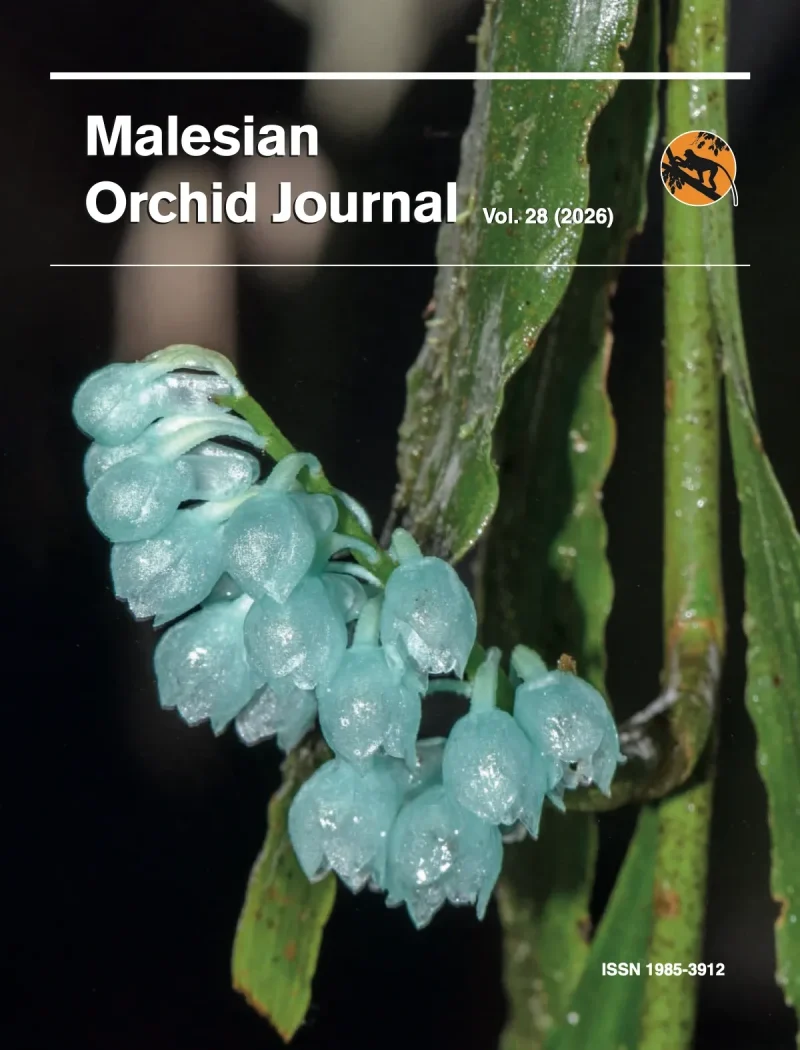
Additional information
| Weight | 0.624 kg |
|---|---|
| Dimensions | 8 × 10.5 in |
| ISSN | 19853912 |
| Editor | André Schuiteman |
| Pages | 136 |



RM100.00
Botanical art and plant taxonomy go hand in hand, or at least they should. Descriptions of new plant species were and are often accompanied by paintings or drawings. In the older literature, pages full of descriptions in Latin with no illustration in sight were more common, but these were deplorable exceptions. Most botanists have traditionally understood the value of illustrations.
Botanical art, being in the interest of science, is subject to many constraints. First and foremost, there is the demand for accuracy: the number of parts, their proportions, shape and position should, ideally, all be as they are in the actual, living plant. In addition, the illustration must show all organs from the most useful angle and at an appropriate scale. Despite these constraints, almost all botanical artists have their own, recognisable style. This is where the art comes in. The best botanical artists combine full control of their medium with a unique, often clever and striking presentation. More thought goes into this kind of work than one may think. Apart from the artistic aspect, a botanical artist should also have a thorough understanding of plant morphology. This is one of the reasons why many botanists have learned to make their own drawings, to ensure scientific accuracy. In the Malesian Orchid Journal, such authors as Jaap Vermeulen, Peter O’Byrne and Ong Poh Teck, to name a few, have all provided excellent illustrations of their own hand.
Nowadays, most new plant species are illustrated with both colour photographs and line drawings. Some would argue that photographs alone are sufficient. I would disagree. Photographs, however well they are lit and composed, often contain areas where the patterns of colour, shade and surface texture produce ambiguity. One thing a good botanical drawing should never be is being ambiguous. Still, there are some cases where a photograph can be superior. In his work on Oberonia, Daniel Geiger often uses scanning electron micrographs (SEMs) to illustrate the tiny flowers of these orchids (e.g., Geiger, 2019). It is undeniable that these are more informative than the line drawings in the literature of this genus. You can literally see every single cell in the flower in a SEM. But Oberonia flowers are exceptional in being both extremely small and relatively flat. Larger and more complex orchid flowers would present technical difficulties, and the SEMs would have to be scaled down so much for display on a page that their advantage in detail would be lost.
Around 360 new taxa have so far been described in the Malesian Orchid Journal. All of these have been illustrated with line drawings, and usually also with colour photographs. Many of those line drawings are of outstanding quality and are delightful to look at, adding tremendous value to our journal. You don’t have to take my word for this. One of the artists who has published here, Yuanito Eliazar from Indonesia, received the first prize in the 2025 edition of the prestigious Margaret Flockton Award for botanical art for his illustration of Coelogyne spinifera, published in Malesian Orchid Journal 25: 12, fig. 1 (2024). Congratulations to Yuanito! Another one of his fine works is published in the present volume (Bulbophyllum tenuilabium, p. 132).
Ong Poh Teck is continuing his valuable work of revising orchid genera for the Flora of Peninsular Malaysia project. The current volume presents his revisions of Cymbidium and Micropera. In addition, Ong is a keen student of orchid pollination, and two papers of his on this subject can be found here: one on Bulbophyllum orientale, next to an extremely useful overview article summarising our knowledge of pollination of Malaysian orchids. Malaysia here includes Sabah and Sarawak as well as Peninsular Malaysia. We learn from the second paper that for less than 6% of the c. 2000 orchid species in Malaysia we know what visits them. There is clearly a lot more work to do.
In 2013, Fanie Venter visited one of the least accessible places in Papua New Guinea (PNG), and that is saying something, because much of PNG is already inaccessible enough. The Hindenburg Wall in the Star Mountains features extremely steep topography and enormous rainfall. Despite this, many interesting orchids could be recorded during the brief visit, and several are presented in an article here, including first records for PNG of Calanthe aquamarina and Dendrobium aprinum, as well as some suspected undescribed species.
Now that the former genus Cadetia is once again included in the mega-genus Dendrobium, the nomenclature of the sections previously recognised in Cadetia needed updating, which I present in a short paper in this volume.
Sumatra is still one of the lesser-known parts of Indonesia, botanically speaking, and new orchid species continue to be found there. Many of these show up in the local orchid trade even before they have been formally named. Wendy Mustaqim and co-authors describe an example of this as Bulbophyllum tenuilabium.
Reference
Geiger, D.L. (2019). Studies on Oberonia 5 (Orchidaceae: Malaxideae). Twenty-four new synonyms, and a corrected spelling. Blumea 64: 123–139 (doi: 10.3767/blumea.2019.64.02.04).
André Schuiteman
Kew
19 December 2025
| Weight | 0.624 kg |
|---|---|
| Dimensions | 8 × 10.5 in |
| ISSN | 19853912 |
| Editor | André Schuiteman |
| Pages | 136 |